
Gazepoint gaze-latency survival analysis
Source:vignettes/articles/gaze-survival-adapter.Rmd
gaze-survival-adapter.RmdWhy this is an adapter, not another survival engine
gp3tools does not duplicate survival-analysis science. gp3tools::prepare_gazepoint_survival_data() and gp3tools::run_gazepoint_latency_analysis() translate a Gazepoint-oriented workflow into the vendor-neutral eyeprocess survival API. Event/censor construction, validation, Cox/AFT fitting, diagnostics, provenance, and reporting remain in eyeprocess.
Use this route only after Gazepoint exports have been represented as explicit trial observation windows and fixation/AOI-visit events. A missing Gazepoint field is not evidence of censoring. A target that is never inspected during a complete usable trial can be right-censored; incomplete or unusable gaze remains a review state.
When to use it
Use censored latency when the scientific outcome is time to first target fixation, first AOI entry, first evidence inspection, first revisit, first transition into a target AOI, or a pre-defined disengagement event, and when some valid trials end before that event occurs.
Do not use this workflow for ordinary fixation-duration summaries, for trials whose observation window cannot be established, or to turn missing/unusable gaze into an artificial never-inspected outcome.
Censoring decision table
| Gazepoint trial state | Survival treatment |
|---|---|
| Target event observed in a complete usable window | Event |
| Target absent when a complete usable window ends | Right censored |
| Missing/incomplete observation window | Review required |
| Gaze quality below the declared rule | Review/exclusion branch |
| Ambiguous trial/event identity | Stop with an error |
The adapter never guesses a censoring state from a missing value alone.
Explicit estimator choices
The convenience workflow intentionally has no default model family:
gp3tools::run_gazepoint_latency_analysis(
  trials,
  events,
  target_aoi = "disclosure",
  formula = "condition",
  cox_structure = "cluster_robust",  # or "frailty"
  aft_distribution = "weibull"      # or "lognormal"
)
cox_structure = “cluster_robust” asks eyeprocess for a marginal Cox model with participant-clustered uncertainty. cox_structure = “frailty” asks for the distinct Gaussian participant-frailty model implemented by the specialist coxme backend. The wrapper never substitutes one for the other.
Fully runnable synthetic example
raw <- eyeprocess::simulate_gaze_survival_inputs(
  "disclosure",
  seed = 20260918,
  n_participants = 36,
  trials_per_participant = 3
)

result <- gp3tools::run_gazepoint_latency_analysis(
  raw$trials,
  raw$events,
  target_aoi = "disclosure",
  formula = "condition",
  participant_col = "participant_id",
  cox_structure = "cluster_robust",
  aft_distribution = "weibull",
  km_group = "condition",
  event_type = "first_fixation",
  condition_col = "condition_id",
  event_detector = "synthetic_truth",
  aoi_specification = "fixed synthetic disclosure AOI",
  quality_rules = list(valid_fraction_min = .90)
)
## Warning: Information criteria are not directly comparable across Cox partial
## likelihood, coxme penalized frailty likelihood, and AFT full likelihood, or
## across different analysis-row counts. Use diagnostics and estimand-specific
## interpretation instead of ranking by AIC/BIC.
result$censoring## n_trials n_analyzable n_observed_events n_censored n_review_required
## 1 108 108 92 16 0
## censoring_fraction
## 1 0.1481481
result$report$effects## term estimate_log_scale std_error hazard_ratio
## 1 conditiondetailed_disclosure 1.377500 0.2344998 3.964979
## 2 conditionminimal_disclosure 1.231458 0.2426759 3.426220
## conf_low conf_high statistic p_value effect_measure
## 1 2.504000 6.278378 5.874207 4.248714e-09 hazard_ratio
## 2 2.129361 5.512916 5.074495 3.885256e-07 hazard_ratio
result$ph_diagnostics## term rho chisq p_value alpha ph_flag
## 1 condition NA 2.636062 0.2676618 0.05 FALSE
## 2 GLOBAL NA 2.636062 0.2676618 0.05 FALSEVisual check
A Kaplan–Meier curve keeps every usable trial in the risk set until the target event occurs or the trial ends. The line style identifies the condition without relying on colour alone.
eyeprocess::plot_gaze_survival_curve(result$data, group = "condition")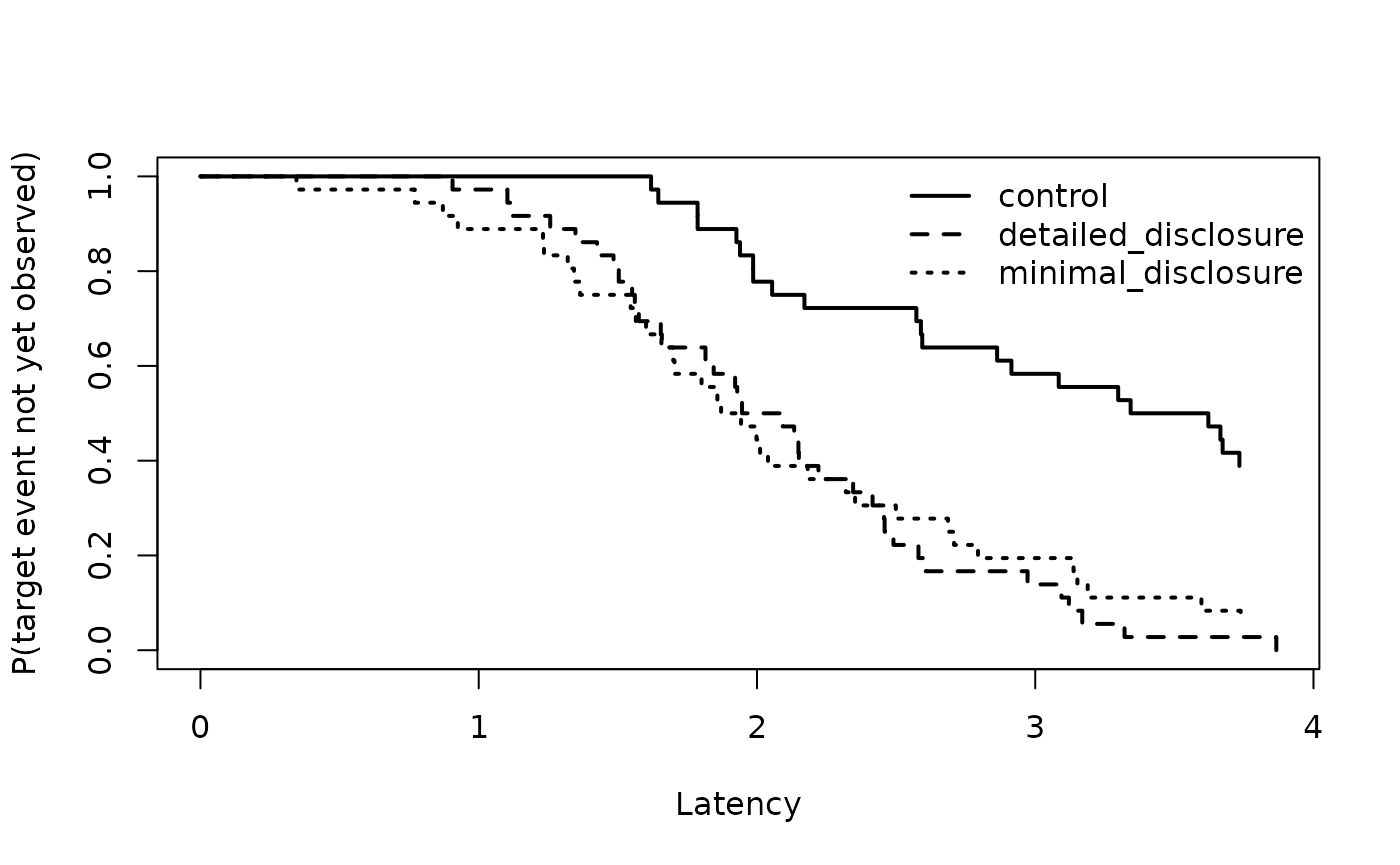
Kaplan–Meier curves for time to first disclosure fixation in the synthetic Gazepoint adapter example.
Complementary survival views
eyeprocess::plot_gaze_cumulative_incidence(
  result$data,
  group = "condition"
)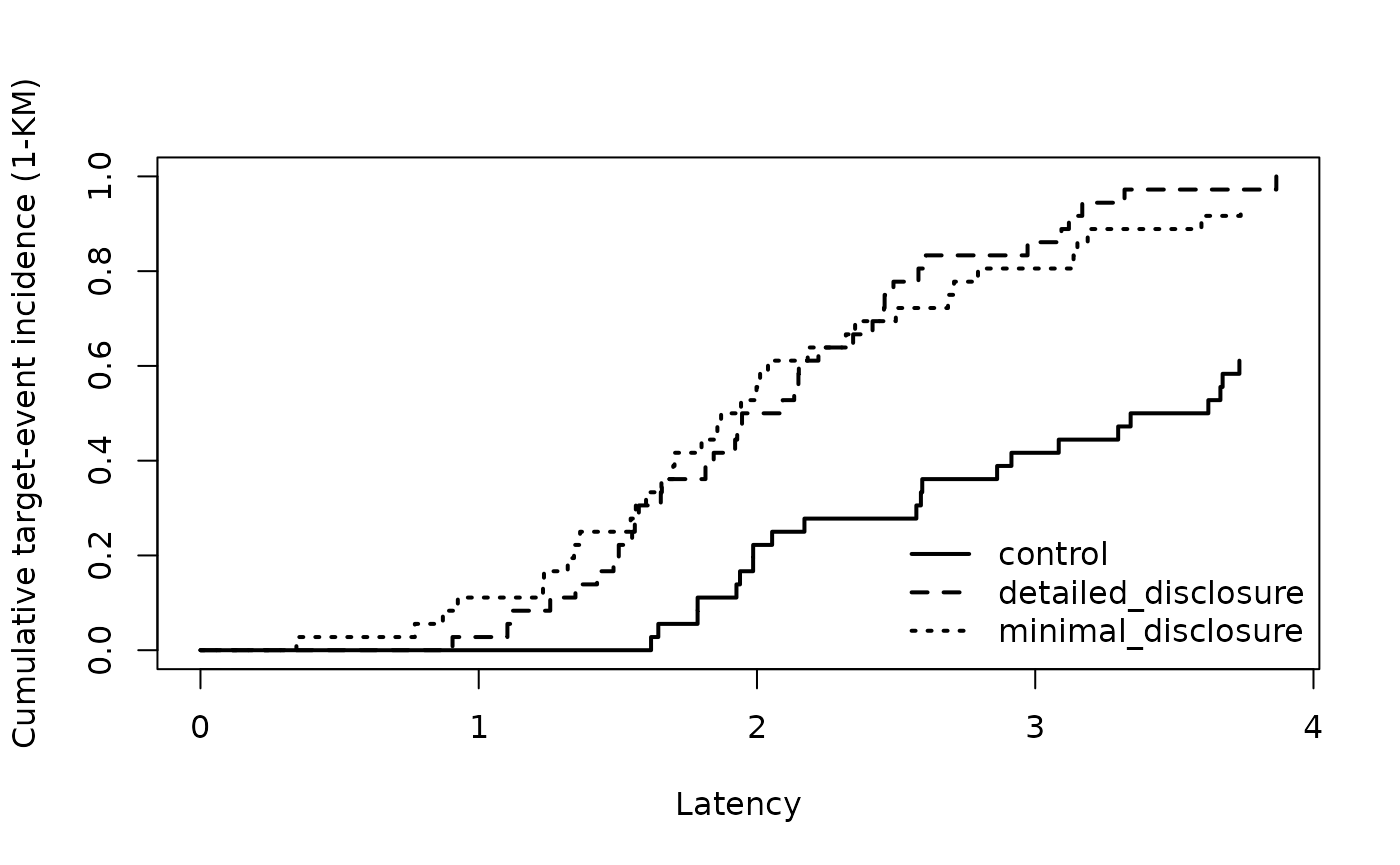
Single-event 1-KM view of the synthetic disclosure-inspection process.
eyeprocess::plot_gaze_hazard(
  result$data,
  group = "condition"
)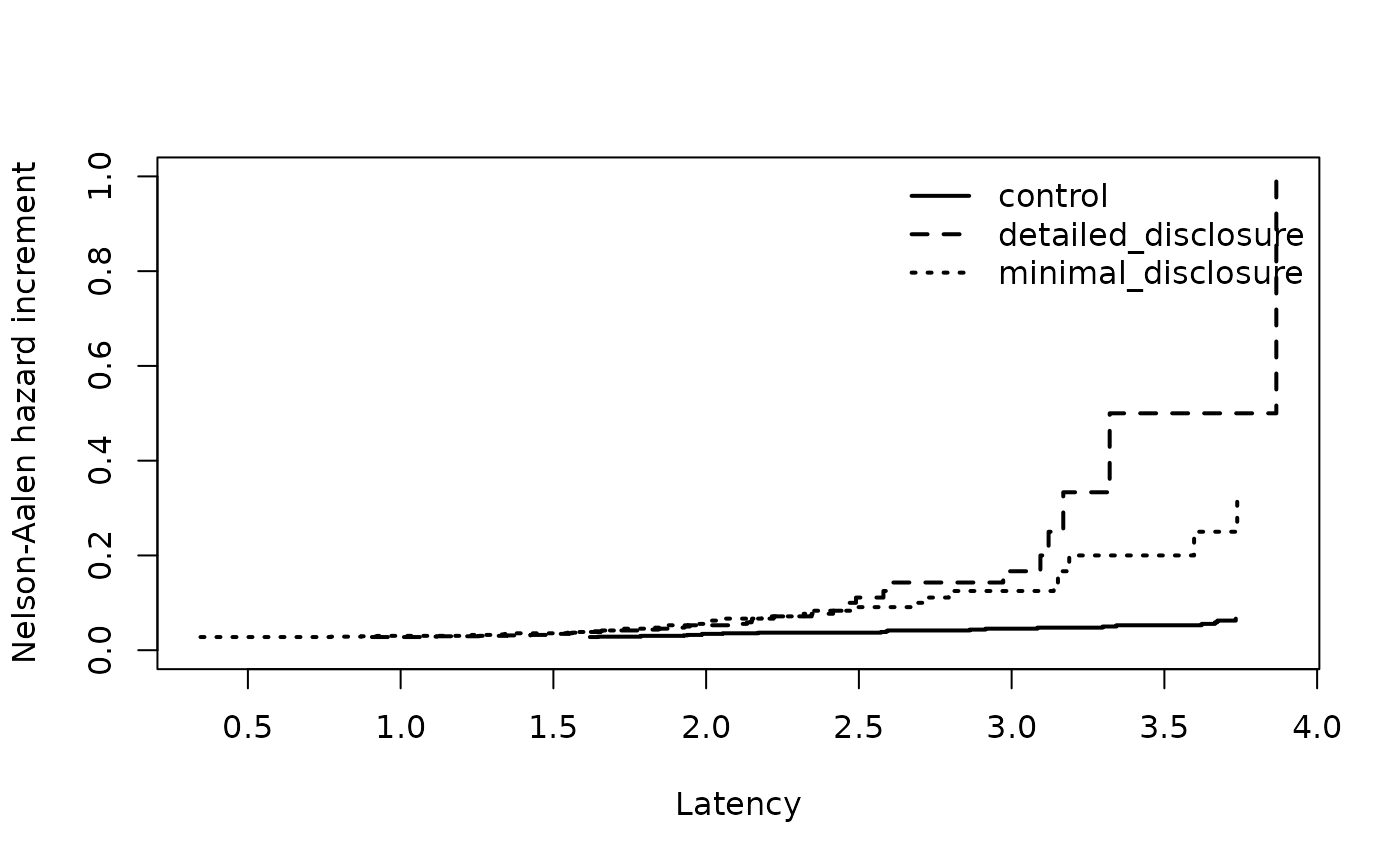
Empirical event/risk increments in the synthetic disclosure-inspection process.
The first plot is simply 1 - KM for one target event; it
is not a competing-risks cumulative-incidence estimator. The second is a
descriptive event/risk increment view rather than a smoothed continuous
hazard estimate.
The output retains never-inspected usable trials instead of deleting them. resultdata retains the eyeprocess provenance fields describing detector, AOI, preprocessing, quality rules, and software version.
Evidence-verification variant
The same adapter can analyse time to first source/evidence inspection without introducing any Gazepoint-specific estimator logic:
verify_raw <- eyeprocess::simulate_gaze_survival_inputs(
  "verification",
  seed = 20260918,
  n_participants = 24,
  trials_per_participant = 3
)

verification <- gp3tools::run_gazepoint_latency_analysis(
  verify_raw$trials,
  verify_raw$events,
  target_aoi = "source_evidence",
  formula = "condition",
  participant_col = "participant_id",
  cox_structure = "cluster_robust",
  aft_distribution = "weibull",
  km_group = "condition",
  event_type = "first_aoi_entry",
  condition_col = "condition_id",
  event_detector = "synthetic_truth",
  aoi_specification = "fixed synthetic source/evidence AOI"
)
## Warning: Information criteria are not directly comparable across Cox partial
## likelihood, coxme penalized frailty likelihood, and AFT full likelihood, or
## across different analysis-row counts. Use diagnostics and estimand-specific
## interpretation instead of ranking by AIC/BIC.
verification$censoring## n_trials n_analyzable n_observed_events n_censored n_review_required
## 1 72 72 68 4 0
## censoring_fraction
## 1 0.05555556The scientific interpretation remains a censored time-to-event analysis: complete trials without an evidence entry remain in the risk set until their observation window ends.
Interpretation
A Cox hazard ratio describes the instantaneous target-event rate among trials still at risk. It is not a ratio of mean TTFF. An AFT time ratio describes multiplicative event time under the named parametric family. Cox partial-likelihood and AFT full-likelihood AIC/BIC values are not automatically comparable; the eyeprocess comparison helper flags this boundary.
For frailty Cox models, survival::cox.zph() is not applied to the coxme object. The wrapper therefore returns an explicit diagnostic-status row and directs the analyst to report the corresponding marginal Cox PH diagnostic separately.
Model-choice quick guide
| Question | Adapter choice | Interpretation |
|---|---|---|
| Describe when Gazepoint trials first inspect the target | Kaplan-Meier output | Remaining uninspected probability |
| Estimate a marginal condition effect across repeated trials | cox_structure = "cluster_robust" |
Marginal hazard ratio |
| Estimate latent participant heterogeneity in R | cox_structure = "frailty" |
Conditional hazard ratio with participant frailty |
| Express multiplicative event-time differences |
aft_distribution = "weibull" or
"lognormal"
|
Time ratio |
The adapter does not select among these estimands. The analyst must name the repeated-Cox structure and AFT family explicitly.
Sensitivity guidance
Rebuild the survival table and rerun the model under pre-specified alternatives that matter scientifically: AOI boundaries, fixation/event detector, trial start marker, minimum fixation duration, quality threshold, clustered versus frailty Cox, Weibull versus log-normal AFT, and transparent exclusion/review rules. Do not merely relabel the same prepared table as a new specification.
Reporting checklist
Report participants and trials, observed events and censored trials, censoring percentage, review-required rows, target event and AOI, time origin and observation-window rule, event detector and fixation-duration rule, gaze-quality criterion, Cox repeated-observation structure, AFT family, effect estimate with 95% CI, PH diagnostic status, sensitivity branches, and the eyeprocess/gp3tools versions.
Copyable reporting template
Gazepoint gaze latency was analysed using the vendor-neutral
eyeprocesssurvival engine throughgp3tools. The target event was [EVENT] within [TARGET AOI], measured from [TIME ORIGIN]. Complete usable trials in which the event did not occur were retained as right-censored observations; unresolved or low-quality trials were not converted to censoring. We fitted [CLUSTER-ROBUST/FRAILTY] Cox and [WEIBULL/LOG-NORMAL] AFT specifications, reporting [HAZARD RATIOS/TIME RATIOS] with 95% confidence intervals. We documented censoring by condition, proportional-hazards diagnostics where applicable, and pre-specified sensitivity analyses across AOI, detector, quality, and model definitions.
Report the eyeprocess and gp3tools versions
together so the scientific engine and vendor-adapter layer are both
reproducible.
Failure cases
The adapter should stop or preserve a review flag rather than silently proceed when trial identity is ambiguous, event time exceeds the observation window, the window is missing, gaze quality is unusable, estimator choice is omitted, or the required eyeprocess survival API is unavailable.
API links
- gp3tools::prepare_gazepoint_survival_data() — thin preparation adapter.
- gp3tools::run_gazepoint_latency_analysis() — thin end-to-end adapter requiring explicit model choices.
- See the eyeprocess Survival Analysis for Gaze Latency article for the full vendor-neutral methodology and model APIs.