From cleaner signals to scientifically better measurements
Research implementation, 21 October 2026 — not a validated device benchmark or released API.
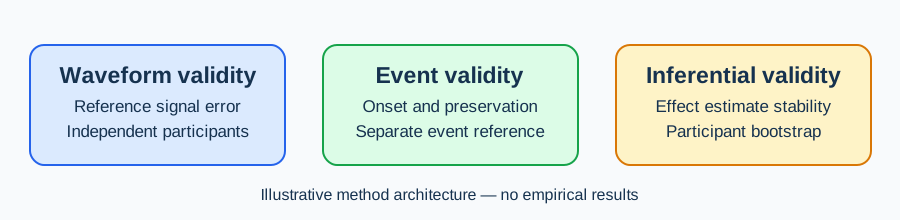
The two experimental helpers under research/october_2026/physiological_validation.py distinguish measurement-level validity from participant-level inferential stability. The original illustration represents three deliberately separate estimands. None is interchangeable with the others.
Reproducible example
import numpy as np
import pandas as pd
from research.october_2026.physiological_validation import baseline_stability_audit, preprocessing_to_inference_audit

baseline = pd.DataFrame({
    "participant_id": ["P1"] * 8 + ["P2"] * 8,
    "time_s": list(range(8)) * 2,
    "value": list(np.linspace(1.0, 1.2, 8)) + [1.1] * 8,
})
print(baseline_stability_audit(baseline).to_string(index=False))
An observed baseline is not necessarily a stable baseline. Slopes, early/late changes and missingness describe the actual reference interval; no fixed stability cutoff is imposed.
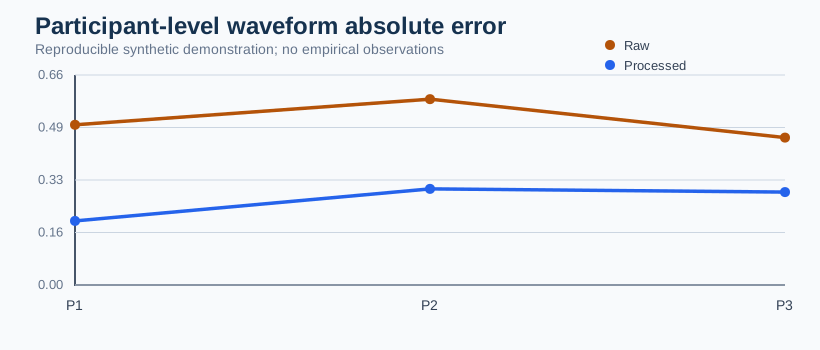
Participant-level difference plot
The following code draws an original synthetic demonstration, not empirical EDA outcomes:
import matplotlib.pyplot as plt
participants = ["P1", "P2", "P3"]
raw_error = [0.50, 0.58, 0.46]
processed_error = [0.20, 0.30, 0.29]
fig, ax = plt.subplots(figsize=(6, 3))
for i, participant in enumerate(participants):
    ax.plot([0, 1], [raw_error[i], processed_error[i]], marker="o", label=participant)
ax.set_xticks([0, 1], ["Raw", "Processed"])
ax.set_ylabel("Synthetic waveform absolute error")
ax.legend(title="Independent unit")
fig.tight_layout()
The complete matched three-layer input requires signal reference, binary event labels on a common grid and separately estimated participant effects. Changes are bootstrapped by participant, not by time sample. Event-label error is not event-onset precision; scientific equivalence requires additional evidence.
Qualification checklist
- Reproduce known-truth waveform and event recovery independently.
- Evaluate event onset and SCR amplitude with an expert reference set.
- Check bias, construct responsiveness and condition effects before and after preprocessing.
- Quantify participant-level uncertainty and negative outcomes.
- Validate stabilization procedures by modality; a cardiovascular protocol is not automatically an EDA or pupil standard.
Status: implementation and synthetic unit tests submitted for review; externally benchmarked clinical or scientific validity is not claimed.
External classifier validation and sensor ablations
The complementary experimental module research/october_2026/external_validation.py checks explicit participant- and dataset-identity disjointness. It reports locked-threshold precision, recall, F1, balanced accuracy, average precision, external class prevalence, and whole-participant bootstrap intervals. It consumes supplied frozen predictions; it cannot prove that the model or threshold really was frozen.
import pandas as pd
from research.october_2026.external_validation import (
    external_classifier_validation, modality_ablation_audit,
)
rows = pd.DataFrame({
    "participant_id": ["A", "A", "B", "B", "C", "C"],
    "dataset_id": ["external"] * 6,
    "outcome": [0, 1] * 3,
    "probability": [.1, .9] * 3,
    "full_probability": [.1, .9] * 3,
    "ablated_probability": [.1, .4] * 3,
})
external = external_classifier_validation(
    rows, training_participants=["development_subject"],
    training_datasets=["development"], locked_threshold=0.5,
)
ablation = modality_ablation_audit(rows)
print(external["metrics"], ablation["delta_balanced_accuracy"])
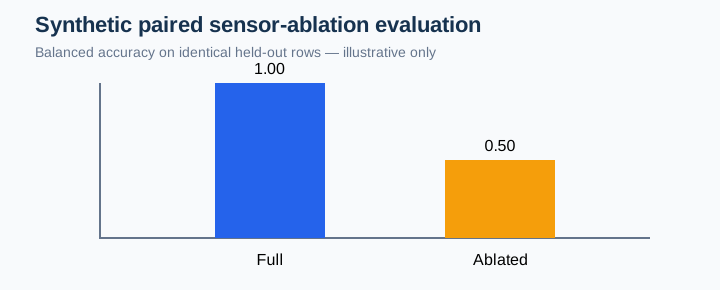
Both the external classifier and ablation checks are descriptive research diagnostics. A statistically meaningful between-modality difference requires prespecified endpoints, valid independent participant units, adequate sample size and external domain evidence. The example is synthetic and establishes no sensor complementarity.
Clock synchronization versus event timing
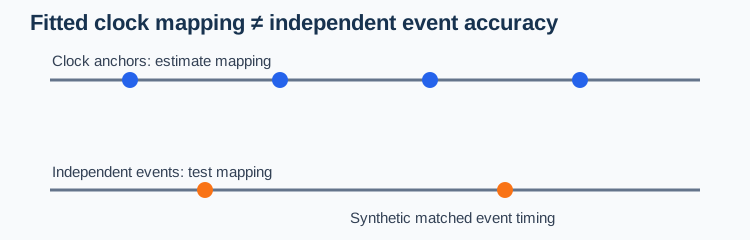
The experimental synchronization_validation.py reports participant/session-specific affine or offset clock mapping from matched anchors and separately evaluates events that were not used as anchors. Low anchor residuals are not sufficient evidence of low event error.
import pandas as pd
from research.october_2026.synchronization_validation import audit_clock_and_event_alignment
anchors = pd.DataFrame({
    "participant_id": ["P"]*4, "session_id":["S"]*4,
    "device_time_s":[1,2,3,4], "reference_time_s":[1.1,2.1,3.1,4.1],
})
events = pd.DataFrame({
    "participant_id":["P"]*2, "session_id":["S"]*2,
    "device_event_time_s":[1.5,3.5], "reference_event_time_s":[1.6,3.6],
})
audit = audit_clock_and_event_alignment(anchors, events, fit="affine")
print(audit["clock_fits"], audit["independent_event_errors"])
The illustration depicts synthetic clocks. Anchor/event independence must be verified from acquisition metadata in empirical use. Even a near-zero affine residual is not a hardware latency certificate.
EDABE external evidence intake (not yet executed on the original dataset)
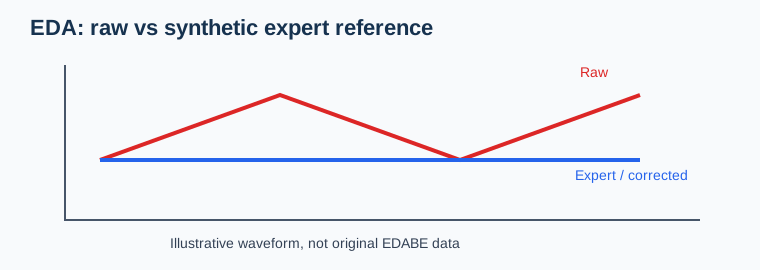
The EDABE benchmark documentation provides raw electrodermal signals, human-edited reference signals and artifact labels. Those labels are not independently annotated skin-conductance responses. The research-only edabe_reference.py adapter requires original export column names, recording IDs, explicit participant-disjoint train/test labels, and matching timestamps before computing waveform error and artifact-label recall.
Primary source: EDABE dataset record; EDABE v2 and research use conditions; FairEDA public reproducibility materials. Dataset access/reuse conditions remain the researcher's responsibility. This repository includes only synthetic fixtures, not copyrighted or restricted underlying recordings.
import pandas as pd
from research.october_2026.edabe_reference import audit_edabe_reference_export
rows = []
for subject, split in [("synthetic-train", "train"), ("synthetic-test", "test")]:
    for time, raw, reference, clean, artifact in [
        (0,1,1,1,0), (1,2,1,1,1), (2,1,1,1,0), (3,2,1,1,1)
    ]:
        rows.append(dict(participant_id=subject, recording_id="trial",
            benchmark_split=split, time=time, rawdata=raw,
            cleandata=reference, signal_automatic=clean,
            binarytarget=artifact, predArtifacts=artifact,
            postProcessedPredArtifacts=artifact))
summary = audit_edabe_reference_export(pd.DataFrame(rows))
print(summary["recording_metrics"])
Pending: obtain properly licensed genuine EDABE data, confirm supplied participant split against the source manifest, compare all algorithms under identical contamination strata, and test SCR/inferential outcomes against separate expert event or experimental references. These results have not been computed here.
AICOS-HAR cross-device validation pathway
AICOS-HAR v1 contains inertial recordings across devices and placements. A legitimate external HAR evaluation requires sensor/site/device metadata, prespecified activities, leave-device/placement-out splits and provenance-constrained thresholds. This is a proposed external validation exercise, not an integration already run and not evidence of eye-tracking or EDA validity. The dataset is approximately 2.5 GB and must be obtained subject to its reuse conditions.
Baseline-window and device-strata sensitivity
The module now exposes baseline_window_sensitivity(), which preserves every prespecified window, including those with insufficient valid observations, rather than selecting the window that favors the desired effect. external_device_placement_strata() analogously retains all device-by-body-placement cells, records class prevalence and participant counts, and refuses to manufacture performance metrics for cells with inadequate independent evidence. These are validation-design helpers, not results from AICOS-HAR or a recommendation for universal baseline durations.
Publication and qualification status (21 October 2026)
This page and its original synthetic figures are merged into the GitHub documentation source. The worked research modules are under research/october_2026/ and are not automatically included in installed PyPI wheels or exported as stable package APIs. Their empirical accuracy, device transfer and inferential calibration are not implied by a green CI test or a successful website build.
The explicit outstanding scientific acceptance criteria and eligible real-data benchmarks are tracked in research-to-release issue #176. This source-only research contribution is separate from the existing stable package version, and a new maintenance release must not claim these experiments as installed features.