Guides
Choose a research workflow
Start from the evidence you actually have, identify the next defensible stage, and move into the relevant guide, example, method page, or API lens.
Use the package from data to report
Run a complete EDA/SCR analysis with real package calls, inspect every QC and processing object, save tables and figures, and learn how to substitute your own export.
First analysis
Go from installation to QC, generated figures, and a reproducible workflow using bundled synthetic data.
Validate a new dataset
Run schema, timing, missingness, signal, event, and provenance checks before substantive analysis.
Research project scaffold
Create a checked raw/metadata/mappings/QC/events/derived/models/figures/reports/manifests/logs structure before private research data enter the workflow.
Study metadata and data dictionary
Declare variable roles, units, clock ownership, provenance, identifiers and event semantics before source columns are standardized or analysis code depends on them.
Bring your own export safely
Preserve an unfamiliar CSV, preview source-to-standard column mappings, verify time and event assumptions, and export a reviewable adaptation manifest before analysis.
Signal and column glossary
Look up common Gazepoint-style EDA, cardiac, TTL, time, identity and fixation fields, and distinguish recorded signals from validity metadata and derived quantities.
Troubleshoot a workflow
Start from the symptom, find the earliest broken assumption, preserve diagnostic evidence, and avoid patching around schema, timing, signal, event, model, or reporting failures.
Timebase and alignment
Separate nominal sampling claims from observed timing evidence and align streams without overstating synchronization accuracy.
Reporting and reproducibility
Retain the settings, QC evidence, software identity, figures, and provenance needed to reproduce and review an analysis.
Choose a modelling strategy
Match continuous or ordinal outcomes, grouping structures, heavy tails, random slopes, and prediction targets to the current method families.
Browse the API
Use the domain browser when you already know the operation you need and want precise signatures rather than a workflow narrative.
Documentation map
| Need | Documentation type | Start here |
|---|---|---|
| I do not yet know which workflow fits | Decision guide | Choose your workflow |
| I want to use the package end to end | Hands-on tutorial | Data to report |
| I want a shorter first tour | Tutorial | First analysis |
| I am setting up a new research project | Project setup | Research project scaffold |
| I need to define field roles, units, clocks and event semantics | Metadata contract | Study metadata and data dictionary |
| I have an unfamiliar CSV/export to adapt | Hands-on adaptation | Bring your own export safely |
| I know a column name but not its role | Reference guide | Signal and column glossary |
| Something failed or the evidence looks wrong | Diagnostics | Troubleshooting and diagnostics |
| I have a research task to complete | How-to | Workflow map and the guides above |
| I need exact function behavior | Reference | API browser |
| I need to understand why the workflow is structured this way | Explanation | Python-native articles |
| I need validation evidence | Evidence | Parity & validation and Deep validation |
Choose your workflow
| What you have now | First question | Recommended route | Evidence to retain |
|---|---|---|---|
| A new project before data intake | How will source data, mappings, QC, events, derived outputs, models and reporting evidence remain separated and traceable? | Research project scaffold, then Study metadata and data dictionary | project structure, configuration template, metadata/dictionary contract, manifests/log policy |
| A new or unfamiliar Gazepoint export | Can I map source columns without losing their original meaning, then verify schema, units and time? | Study metadata and data dictionary, Bring your own export safely, then Validate a new dataset and Signal/column glossary | reviewed field roles/units/clocks, source-to-standard map, schema/QC tables, source identity, timebase evidence |
| EDA/GSR waveform | Is the conductance signal usable before decomposition or event detection? | EDA / GSR / SCR example | unit audit, signal QC, decomposition settings, candidate-event criteria |
| PPG waveform or IBI/RR series | What is the source of each interval and are rejected beats visible? | PPG / HRV example | source provenance, peak/interval QC, rejection rules |
| Pupil, gaze, fixation or AOI fields | Which columns are measured, derived, validity-coded or interpolated? | Pupil / gaze / AOI example | validity/missingness evidence, preprocessing choices, AOI definitions |
| TTL/task events or multiple sensor streams | Which clock owns each timestamp and what alignment evidence exists? | Timebase and alignment then Multimodal example | event identity, clock mapping, offsets/drift, overlap and residuals |
| A warning, empty output, or implausible result | Which earlier assumption failed first? | Troubleshooting and diagnostics | minimal reproduction, schema/time/QC evidence, exact warning/error, settings |
| Analysis-ready repeated observations | What is the scientific generalisation unit and prediction target? | Choose a modelling strategy | grouping structure, holdout unit, model assumptions, uncertainty |
| Completed analysis | Can another researcher replay the decisions and inspect QC? | Reporting and reproducibility | software identity, settings, exclusions, figures, tables, provenance |
| An external analysis ecosystem | What representation and metadata does the downstream tool require? | Interoperability example | explicit conversion, version identity, retained source columns |
Seven-stage decision sequence
Visual checkpoints
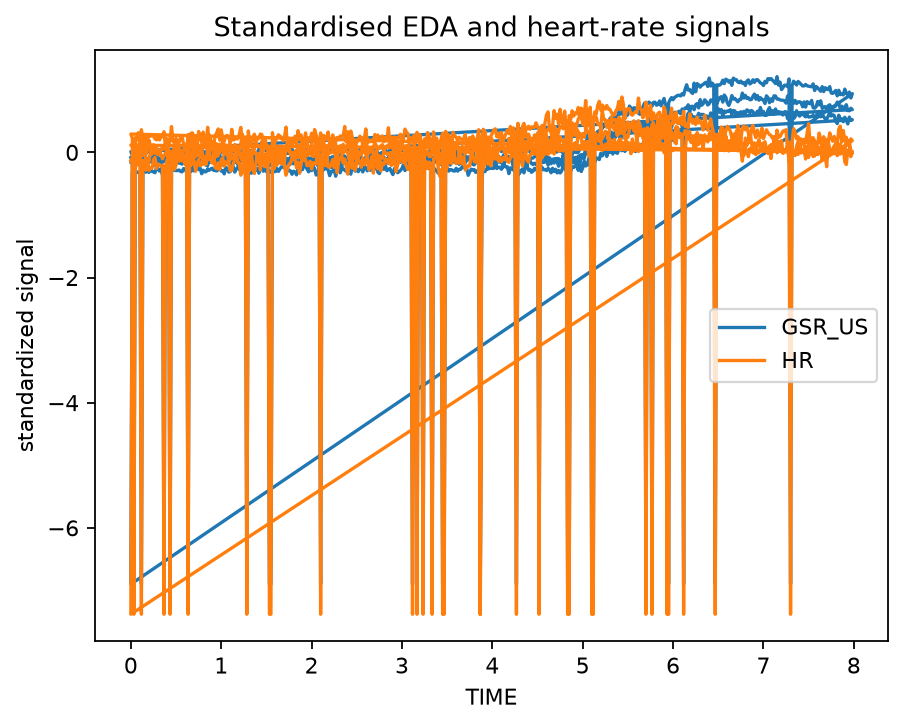
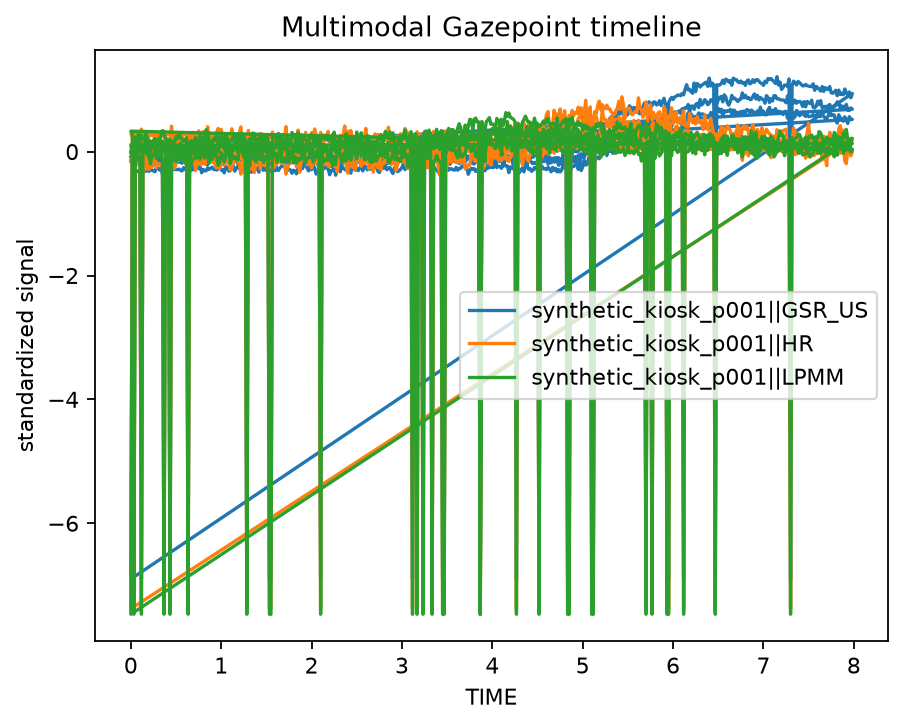
Stop rather than guess
Do not advance a workflow merely because a function can run. Stop and resolve the evidence gap when the timebase is ambiguous, the signal source is unknown, event coverage is incomplete, a denominator has changed silently, or the grouping structure does not support the intended generalisation. The package should make those decisions inspectable rather than conceal them behind a successful return value.
Need a concrete starting script?
Open Examples for short, verified research recipes that connect TTL events, multimodal summaries, AOI dwell and visual timeline checks.
Safe defaults
- Start from bundled synthetic/public demonstration data when learning or testing a pipeline.
- Treat metadata, QC and provenance as evidence-producing stages, not hidden preprocessing details.
- Hold out whole groups when the scientific target is generalisation to unseen groups.
- Keep conditional predictions for observed participants/items separate from population predictions for unseen levels.
- Report timing uncertainty and source identity explicitly when multimodal or cardiac measures depend on them.
- Prefer a simpler model whose assumptions you can defend over a richer model whose latent structure is weakly identified.