Multimodal event-alignment example
Use this route when eye tracking, physiology, task events, TTL markers, or external streams need to be interpreted on a common timeline. The workflow makes timing evidence explicit before event-locked summaries are created.
1. Load the demonstration
import gpbiometricspy as gp

dat = (
    gp.load_kiosk_demo(participants=["synthetic_kiosk_p001"])
    .copy()
    .iloc[:1800]
    .reset_index(drop=True)
)
2. Extract task/TTL events
events = gp.extract_gazepoint_ttl_events(
    dat,
    ttl_columns=["TTL0"],
    group_columns=["participant_id"],
)
Inspect event identity and coverage before using the event table as a timing truth source.
3. Audit the signal timebase
For multiple clock domains, continue with the timebase provenance and multimodal alignment layer rather than assuming equal clocks from matching labels.
4. Build event-locked summaries
summary = gp.summarize_gazepoint_eventlocked_multimodal(
    dat,
    events=events,
    time_col="TIME",
    event_time_col="TIME",
    signal_cols=["GSR_US", "HR", "LPMM"],
    group_cols=["participant_id"],
)
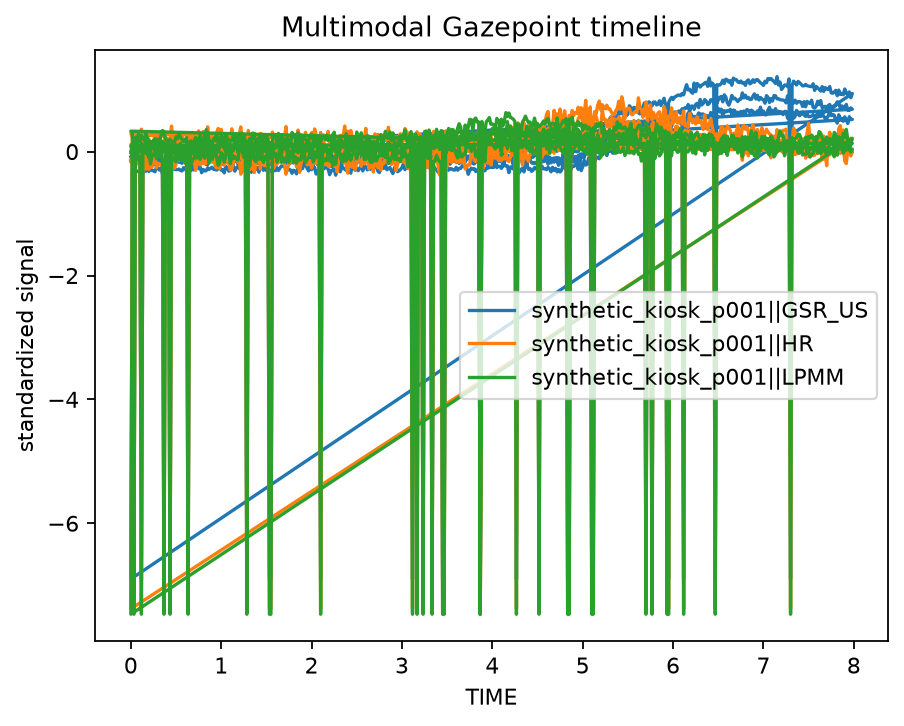
5. Inspect the shared timeline
fig = gp.plot_gazepoint_multimodal_timeline(
    dat,
    time_col="TIME",
    signal_cols=["GSR_US", "HR", "LPMM"],
    group_cols=["participant_id"],
    title="Multimodal Gazepoint timeline",
)
When another clock is involved
A second stream should bring its own timing evidence. A defensible alignment record includes:
- original timestamps/counters for each stream;
- clock identity;
- matched anchors or declared offsets;
- offset/drift mapping;
- residuals after alignment;
- corrected overlap interval;
- any interpolation/resampling performed after clock correction.
The Timebase and alignment guide gives the complete order of operations.
Practical checklist
- Verify TTL edge/event semantics.
- Audit duplicate/missing events and participant/trial coverage.
- Confirm which clock each timestamp belongs to.
- Estimate rather than assume offsets when anchors exist.
- Keep clock correction separate from interpolation.
- Check that corrected streams have positive temporal overlap.
- Define event windows only at a precision supported by the timing evidence.
Scientific boundary
Alignment establishes a declared temporal relation among recorded streams. It does not by itself prove hardware synchronization, causal order, sensor validity, or psychological meaning of any channel.