Synthetic data showcase
Frozen R source: reference/vignettes/articles/synthetic-data-showcase.Rmd
This page is the Python migration companion for the corresponding gpbiometrics 2.0.0 article. The original R article is retained verbatim in reference/vignettes/; this companion identifies the matching Python API so the scientific workflow can be reproduced without hiding the reference implementation.
Python API crosswalk
The frozen R article calls the following exported functions; all are available under the same names in gpbiometricspy:
gp.align_gazepoint_biometrics_to_ttl(...)gp.audit_gazepoint_gsr_quality(...)gp.audit_gazepoint_gsr_units(...)gp.audit_gazepoint_ibi_quality(...)gp.build_gazepoint_aoi_timecourse(...)gp.convert_gazepoint_gsr_to_conductance(...)gp.create_gazepoint_analysis_decision_log(...)gp.create_gazepoint_biometrics_report_tables(...)gp.create_gazepoint_qc_supplement(...)gp.create_gazepoint_reproducibility_statement(...)gp.decompose_gazepoint_eda(...)gp.detect_active_biometric_channels(...)gp.detect_gazepoint_biometric_schema(...)gp.detect_gazepoint_biometric_timebase(...)gp.detect_gazepoint_ppg_peaks(...)gp.detect_gazepoint_pupil_blinks(...)gp.detect_gazepoint_scr_events(...)gp.estimate_gazepoint_respiration_from_ppg(...)gp.extract_gazepoint_hrv_features(...)gp.extract_gazepoint_ttl_events(...)gp.filter_gazepoint_gaze(...)gp.filter_gazepoint_ppg_signal(...)gp.flag_gazepoint_ppg_quality(...)gp.join_gazepoint_biometrics_to_master(...)gp.prepare_gazepoint_aoi_biometrics_model_data(...)gp.prepare_gazepoint_multimodal_model_data(...)gp.profile_gazepoint_export_folder(...)gp.recommend_gazepoint_biometric_exclusions(...)gp.run_gazepoint_biometrics_real_data_readiness(...)gp.run_gazepoint_biometrics_workflow(...)gp.simulate_gazepoint_artifact(...)gp.simulate_gazepoint_biometrics(...)gp.simulate_gazepoint_eye_data(...)gp.simulate_gazepoint_multimodal_data(...)gp.smooth_gazepoint_pupil(...)gp.standardise_gazepoint_biometric_names(...)gp.standardize_gazepoint_column_names(...)gp.summarise_gazepoint_aoi_biometrics(...)gp.summarise_gazepoint_ibi_windows(...)gp.summarise_gazepoint_multimodal_windows(...)gp.summarise_gazepoint_scr_event_windows(...)gp.summarize_gazepoint_export_inventory(...)gp.summarize_gazepoint_missingness(...)gp.summarize_gazepoint_pupil_events(...)gp.summarize_gazepoint_qc_overview(...)gp.sync_gazepoint_biometrics_with_gaze(...)gp.validate_gazepoint_biometrics(...)gp.validate_gazepoint_format(...)gp.validate_gazepoint_metadata(...)gp.write_gazepoint_export_profile(...)
import gpbiometricspy as gp

# Example entry point from this workflow
# result = gp.align_gazepoint_biometrics_to_ttl(...)
Interpretation
Use the same conservative physiological interpretation as the R package: derived biometric features are signal-processing outputs and do not directly establish emotion, stress, cognition, preference, health status, or diagnosis.
Executable Python companion
The frozen R call crosswalk above is retained for completeness. The following companion is an executable end-to-end Python workflow using synthetic/public data and the same scientific domain. It is also executed by the test suite.
Run from the repository root:
from __future__ import annotations
from _shared import *
bio=gp.simulate_gazepoint_biometrics(n_seconds=5,sampling_rate=20,seed=1); eye=gp.simulate_gazepoint_eye_data({'n_samples':100,'seed':2}); multi=gp.simulate_gazepoint_multimodal_data(duration_s=5,sampling_rate_hz=20,seed=3); artifact=gp.simulate_gazepoint_artifact(bio,signal_cols=['GSR_US'],artifact='spike',seed=4); finish('synthetic-data-showcase',biometrics=bio,eye=eye,multimodal=multi,artifact=artifact)
Rendered Python output
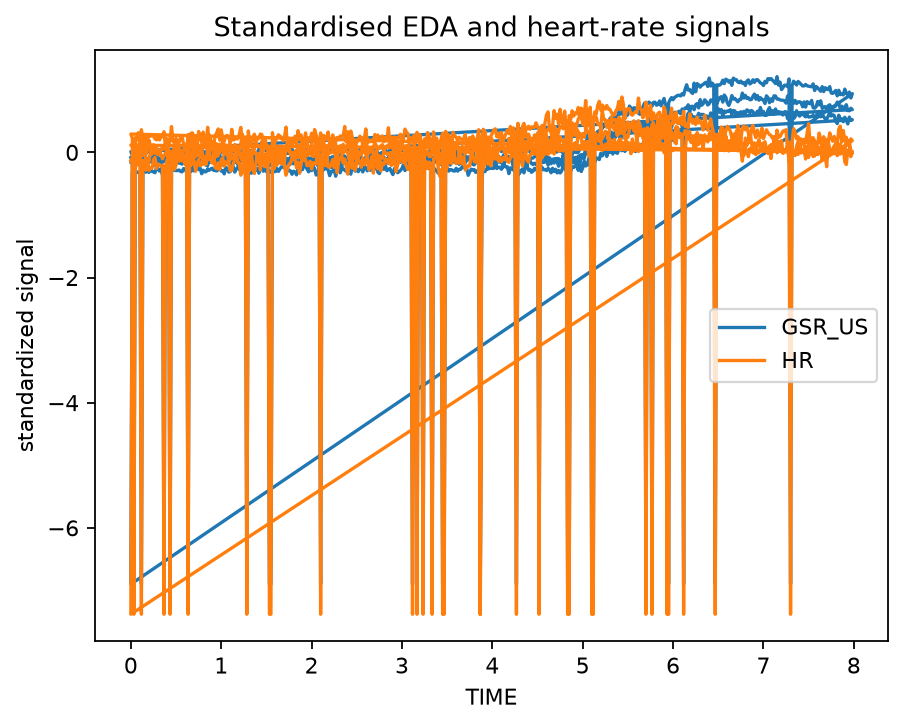
These figures are generated from bundled synthetic/public data by scripts/generate_docs_gallery.py using the current Python plotting API.
Biometric signal overview