Plot multiple Gazepoint scanpaths
Source:R/scanpath_qc_plot_extensions.R
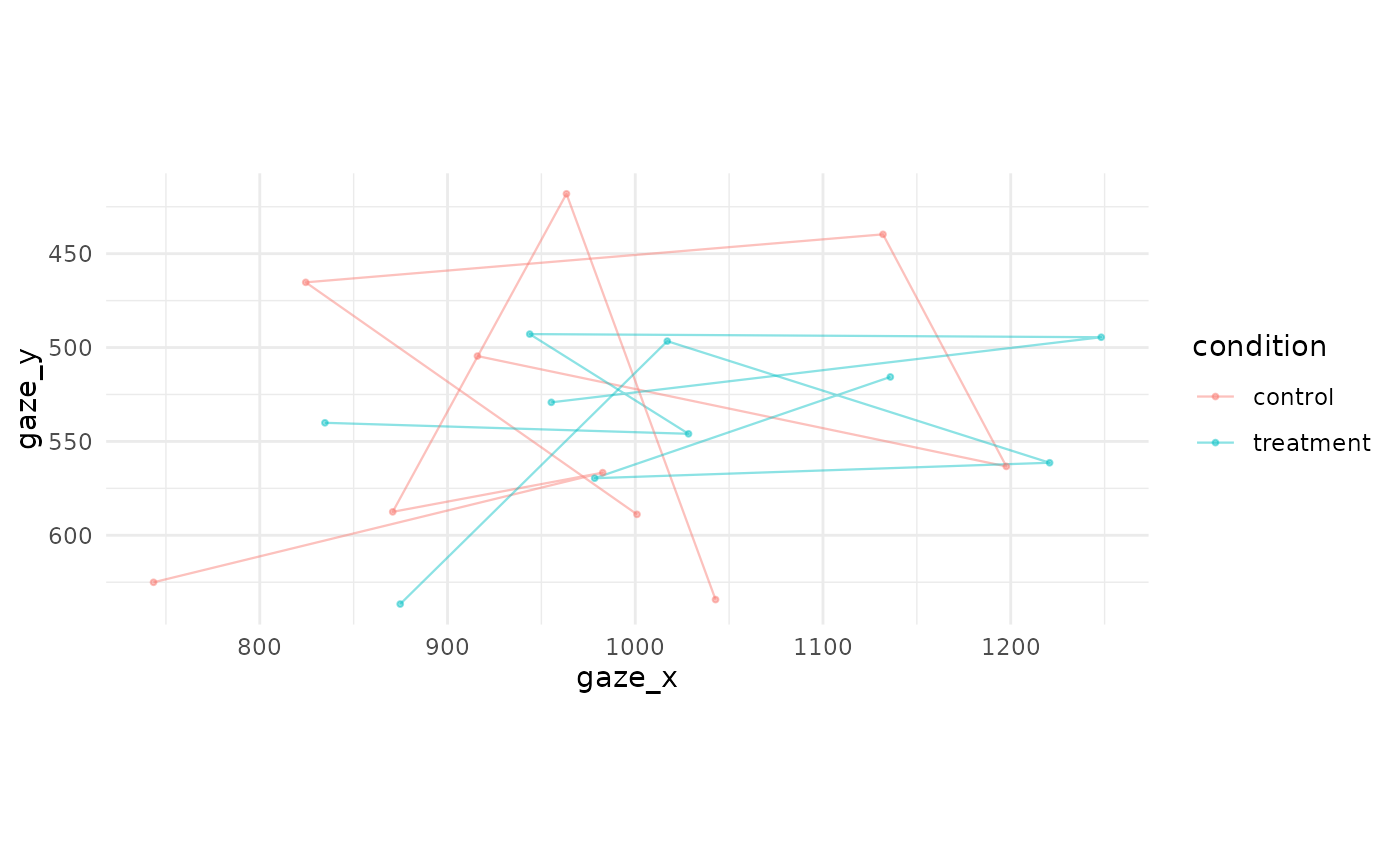
plot_gazepoint_scanpaths.RdCreates a descriptive multi-scanpath plot from gaze coordinates. This helper is intended for visual quality review, participant/trial inspection, and documentation examples. It should not be interpreted as an inferential scanpath-comparison method.
Usage
plot_gazepoint_scanpaths(
  data,
  x_col,
  y_col,
  order_col = NULL,
  group_cols = NULL,
  colour_col = NULL,
  facet_col = NULL,
  screen_width = NULL,
  screen_height = NULL,
  reverse_y = TRUE,
  show_points = TRUE,
  alpha = 0.45,
  linewidth = 0.4,
  point_size = 0.7,
  title = NULL
)
Arguments
- data
A data frame.
- x_col, y_col
Character names of gaze coordinate columns.
- order_col
Optional column used to order gaze samples before plotting.
- group_cols
Optional character vector used to define separate paths.
- colour_col
Optional column used for colour.
- facet_col
Optional column used for faceting.
- screen_width, screen_height
Optional screen dimensions. If supplied, axis limits are set to the screen bounds.
- reverse_y
If
TRUE, reverses the y-axis so the origin is displayed at the top-left, matching common screen-coordinate conventions.- show_points
If
TRUE, sample points are added on top of paths.- alpha
Line opacity.
- linewidth
Line width.
- point_size
Point size when
show_points = TRUE.- title
Optional plot title.
Examples
x <- simulate_gazepoint_pupil_data(n_subjects = 2, n_trials = 2, n_time_bins = 5, seed = 1)
plot_gazepoint_scanpaths(
  x,
  x_col = "gaze_x",
  y_col = "gaze_y",
  order_col = "time_bin",
  group_cols = c("subject", "trial"),
  colour_col = "condition"
)