Visual complexity and gaze-contingent luminance in pupil analysis
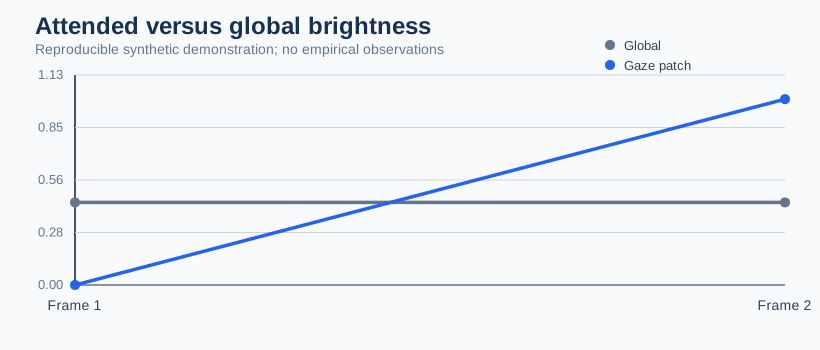
Experimental visual-feature extraction and sensitivity diagnostics (October 2026). The functions here are not Bayesian posterior estimators and do not supply a validated causal correction for pupil response.
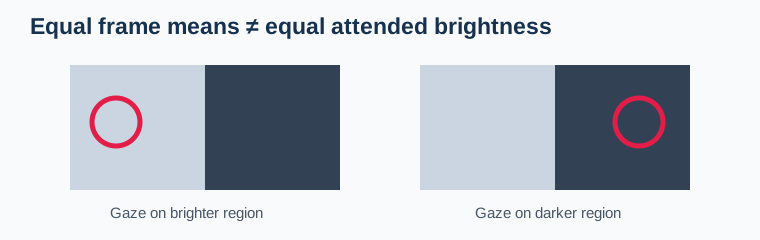
A screen's average brightness can stay constant while the participant fixates a darker or brighter region. The experimental extract_gaze_contingent_features() pairs normalized gaze locations with synchronized grayscale stimulus frames and computes patch-average brightness plus orientation-distribution entropy.
Executable synthetic example
import numpy as np
from research.october_2026.stimulus_covariates import extract_gaze_contingent_features

stimulus = np.zeros((9, 9))
stimulus[:, 5:] = 1
frames = np.stack([stimulus, stimulus])
gaze_xy = [[.1, .5], [.9, .5]]
features = extract_gaze_contingent_features(frames, gaze_xy, radius_px=1)
print(features)
Original plot recipe
import matplotlib.pyplot as plt
fig, ax = plt.subplots(figsize=(5, 3))
ax.plot(features.frame_index, features.global_brightness, "o-", label="Whole image")
ax.plot(features.frame_index, features.attended_patch_brightness, "s-", label="Gaze region")
ax.set(xlabel="Synthetic frame", ylabel="Normalized image brightness")
ax.legend()
fig.tight_layout()
The optional pupil_adjustment_design_audit() compares a declared within-participant condition contrast before and after including image-feature covariates in a descriptive OLS sensitivity design. It refuses collinear designs and makes no Bayesian inference.
Scientific boundaries
- Gray pixel intensity is not calibrated retinal luminance.
- Orientation entropy estimated from generic pictures is not yet a universal physiological complexity correction.
- A covariate can be part of the experimental treatment mechanism; adjustment may change the estimand.
- Video/gaze synchronization, frame provenance, contrast, viewing geometry and participant bootstrap validation remain necessary before any substantive pupillometry claim.
Publication and qualification status (21 October 2026)
This page and its original synthetic figures are merged into the GitHub documentation source. The worked research modules are under research/october_2026/ and are not automatically included in installed PyPI wheels or exported as stable package APIs. Their empirical accuracy, device transfer and inferential calibration are not implied by a green CI test or a successful website build.
The explicit outstanding scientific acceptance criteria and eligible real-data benchmarks are tracked in research-to-release issue #23. This source-only research contribution is separate from the existing stable package version, and a new maintenance release must not claim these experiments as installed features.