Bayesian multilevel gaze mediation
Method overview
gp3bayespy fits the inferential layer after eyeprocesspy has prepared a canonical repeated-measures mediation object. The simple model separates within- and between-participant paths:
Mediator:
M_ij ~ a_W X_within_ij + a_B X_between_i + participant effects

Outcome:
Y_ij ~ c'_W X_within_ij + b_W M_within_ij
     + c'_B X_between_i + b_B M_between_i
     + participant effects
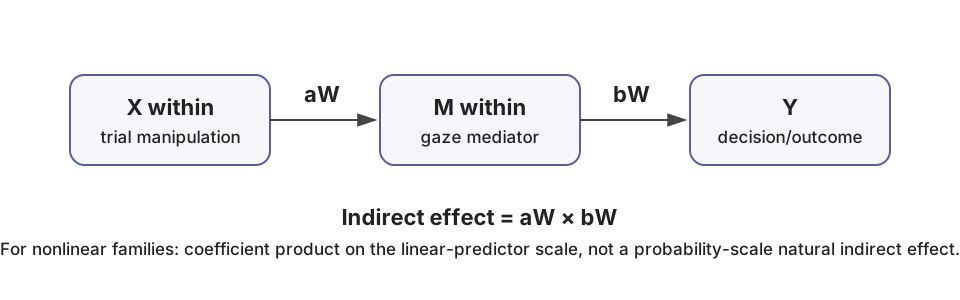
The primary estimand is the within-participant posterior product a_W × b_W on the linear-predictor product scale. A between-participant product a_B × b_B is returned only when the observed design contains enough between-person variation to identify both constituent paths; balanced within-subject manipulations often make X_between constant.
Supported families
Mediator families: Gaussian, lognormal, Gamma, beta, Bernoulli, Poisson, and negative binomial.
Outcome families: Gaussian, Bernoulli/logistic, Poisson, negative binomial, and ordinal when supported by the backend.
The package does not coerce gaze variables to Gaussian merely for convenience.
First model
from gp3bayespy import (
    create_mediation_prior_specification,
    fit_multilevel_gaze_mediation,
    estimate_within_indirect_effect,
)

priors = create_mediation_prior_specification(
    intercept_sd=2.5,
    coefficient_sd=1.0,
    group_sd_scale=1.0,
)

fit = fit_multilevel_gaze_mediation(
    prepared,
    mediator_family="lognormal",
    outcome_family="bernoulli",
    priors=priors,
    random_slopes=("mediator_x", "outcome_m"),
    missingness_policy="quality_eligible",
    chains=4,
    draws=1000,
    tune=1000,
    seed=2026,
)

indirect = estimate_within_indirect_effect(fit)
Missingness is explicit
The default missingness_policy="error" blocks fitting when incomplete or quality-ineligible rows are present. Analysts must choose complete_case or quality_eligible explicitly after reviewing the eyeprocesspy audits. Excluded row positions are stored in the model specification.
Convergence is a gate
check_mediation_convergence() evaluates R-hat, bulk ESS, divergences, and maximum-tree-depth hits. Indirect-effect extraction fails by default when the convergence gate fails. require_convergence=False exists for diagnostic inspection, not for substantive reporting.
Nonlinear outcomes
For Bernoulli, ordinal, and count outcomes, the coefficient product is on the model's linear-predictor scale. It must not be described as a probability-scale natural indirect effect. Probability-scale mediation requires a separate counterfactual/predictive estimand and additional assumptions.
Use / do not use
Use this model when repeated trial-level mediator and outcome measurements exist and the temporal/mechanistic ordering is defensible. Do not use it to manufacture a causal mechanism from cross-sectional correlations, or when the trial-level mediator is measured after the outcome.
Visual interpretation
This is a deterministic synthetic illustration of the linear-predictor product scale, not a posterior from a real study. In an actual analysis the plotted distribution must come from the fitted model and is blocked from substantive reporting when critical convergence checks fail.
Method guide
- Worked AI-advice example
- Choosing mediator and outcome families
- Worked non-Gaussian family contracts
- Interpretation and estimands
- Assumptions and limitations
- Analysis plan and preregistration template
- Diagnostics and priors
- Worked prior-sensitivity example
- Simulation and recovery planning
- Model comparison for mediation
- Serial and moderated extensions
- Reporting guidance
- Worked reporting example
- Troubleshooting
- API map
Runnable examples
examples/multilevel_gaze_mediation_contract.pydemonstrates the deterministic preparation → prior → specification contract without sampling.examples/multilevel_gaze_mediation_failure_cases.pydemonstrates the explicit missingness gate and a balanced within-subject design where between-X paths are not estimable.examples/multilevel_gaze_mediation_family_contracts.pyvalidates lognormal, Gamma, beta, Bernoulli, Poisson, and negative-binomial mediator contracts without sampling.examples/multilevel_gaze_mediation_prior_sensitivity_contract.pyholds the data/model contract fixed while varying a declared coefficient-prior scale.examples/multilevel_gaze_mediation_simulation_recovery_contract.pymaterializes weak, moderate, and strong known-truth design scenarios without faking a sampler run.
These examples are synthetic and CI-small. Posterior examples belong in backend-enabled validation because sampling must never be faked.