Delivered gaze samples are not the nominal sampling rate
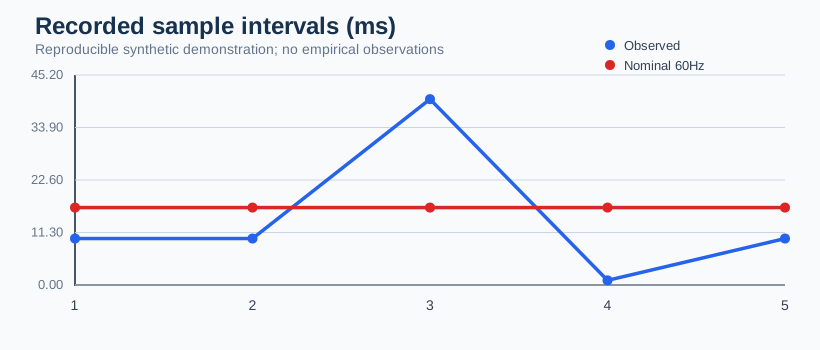
This October 2026 research-only module audits the timestamp process and preserves the distinction between requested rate, native rate, SDK rate and downstream analysis grid. No hardware sampling rate or cross-device event synchronization is inferred from interpolation.
Worked deterministic example
from research.october_2026.acquisition_and_dispersion import acquisition_integrity_certificate

certificate = acquisition_integrity_certificate(
    [0, .010, .020, .060, .061, .071],
    native_rate_hz=60,
    sdk_rate_hz=60,
    analysis_grid_rate_hz=500,
)
print(certificate)
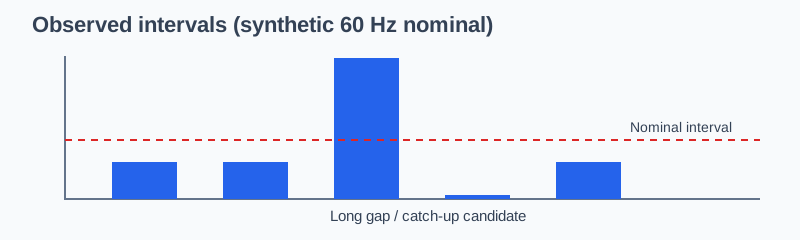
The long interval followed by a short one is a catch-up candidate, not proof of which software or hardware layer introduced the irregularity. Report tails, gaps and validity flags alongside empirical effective rate.
Original plotted diagnostic
import matplotlib.pyplot as plt
timestamps = [0, .010, .020, .060, .061, .071]
dt_ms = [1000 * (b - a) for a, b in zip(timestamps, timestamps[1:])]
fig, ax = plt.subplots(figsize=(7, 3))
ax.bar(range(1, len(dt_ms) + 1), dt_ms)
ax.axhline(1000 / 60, color="k", linestyle="--", label="Nominal 60 Hz")
ax.set(xlabel="Observed sample interval", ylabel="Duration (ms)")
ax.legend()
fig.tight_layout()
A separate dispersion_interpretation_audit() requires target visual angle, eccentricity, task and calibration-versus-task context before a BCEA68-style quantity is interpreted. Task fixation dispersion is not automatically an instrument precision estimate.
Claims not authorized: externally validated sampling stability, spatial calibration accuracy, sensor clock drift or causal attribution of observed burst patterns. The image and plot code use synthetic timestamps only.
Publication and qualification status (21 October 2026)
This page and its original synthetic figures are merged into the GitHub documentation source. The worked research modules are under research/october_2026/ and are not automatically included in installed PyPI wheels or exported as stable package APIs. Their empirical accuracy, device transfer and inferential calibration are not implied by a green CI test or a successful website build.
The explicit outstanding scientific acceptance criteria and eligible real-data benchmarks are tracked in research-to-release issue #25. This source-only research contribution is separate from the existing stable package version, and a new maintenance release must not claim these experiments as installed features.