Worked example: 2-D evidence inspection
This example treats the whole x/y gaze path as the functional observation.
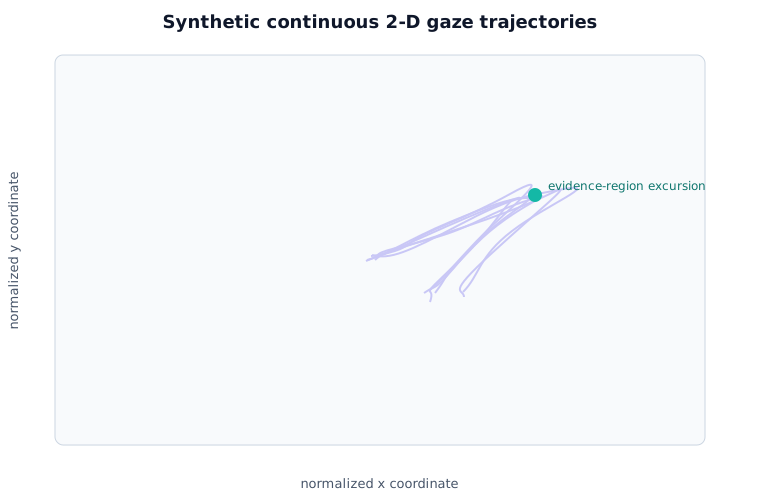
Illustrative synthetic trajectories generated from the package's evidence-inspection simulator. The figure is explanatory, not empirical data.
from eyetrajectoriespy import (
    fit_mfpca,
    fpca_reporting_text,
    plot_fpca_component,
    simulate_planar_trajectories,
)

gaze = simulate_planar_trajectories(
    n_participants=30,
    trials_per_participant=6,
    n_time=121,
    random_state=7,
)

fit = fit_mfpca(
    gaze,
    n_components=0.95,
    scaling="dimension_sd",
)

print(fpca_reporting_text(fit))
plot_fpca_component(fit, component=0, dimension="x")
plot_fpca_component(fit, component=0, dimension="y")
Interpretation workflow
- Inspect the mean trajectory.
- Plot x and y modes for every retained component.
- Map spatial excursions onto known stimulus geometry.
- Inspect score distributions by condition only after the trajectory mode is understood.
- Avoid naming an FPC as a psychological construct without validation.
Reporting example
Joint multivariate functional PCA was fitted to normalized horizontal and vertical gaze coordinates over the 2-s trial window. Functional dimensions were scaled to equal integrated variance before decomposition. Components were retained to explain at least 95% of fitted functional variance. Component interpretation used mean ±2 score-SD trajectories in both coordinate dimensions.